Short answer
Bird control in San Jose is exclusion work: netting openings, spiking or angling ledges, screening vents and signs so pigeons cannot land or nest. Deterrent gadgets and noise devices stop working within weeks because birds habituate. Timing matters legally, since many species and active nests are protected, and we work within those rules.
Pigeons are the usual subject, and they are creatures of habit with strong site loyalty. That is why decoys, spinners and noise makers fail: the birds learn the threat is empty and return within a few weeks. Physical exclusion does not rely on their judgment, which is why it is the only thing that holds.
The second half is sanitation. Accumulated droppings corrode building materials, create a slip hazard, and harbor bird mites that move indoors when the birds are displaced. Cleanup is done with proper controls rather than a hose and a broom, and it needs to happen alongside exclusion so the site is both unusable and clean.
What bird work costs depends on
Exclusion is priced by the surface being covered and the access needed to reach it, so the survey settles the number.
| What moves the price | How it moves it |
|---|---|
| Linear and square footage | Netting is priced by area; spikes and ledge work by linear feet. |
| Height and access | Lifts, scaffolding and roof access add real cost on larger buildings. |
| Surface complexity | Irregular architecture needs more fixings and more careful installation. |
| Cleanup volume | Years of accumulated droppings mean a substantial cleaning phase before install. |
| Number of sites | Vents, signs and ledges each get handled individually on the same building. |
| Materials | Netting, stainless spikes and ledge angles differ in material cost per foot. |
Bird work is quoted from the survey with cleanup and installation itemized separately, so you can see what each part costs.
Pigeon netting
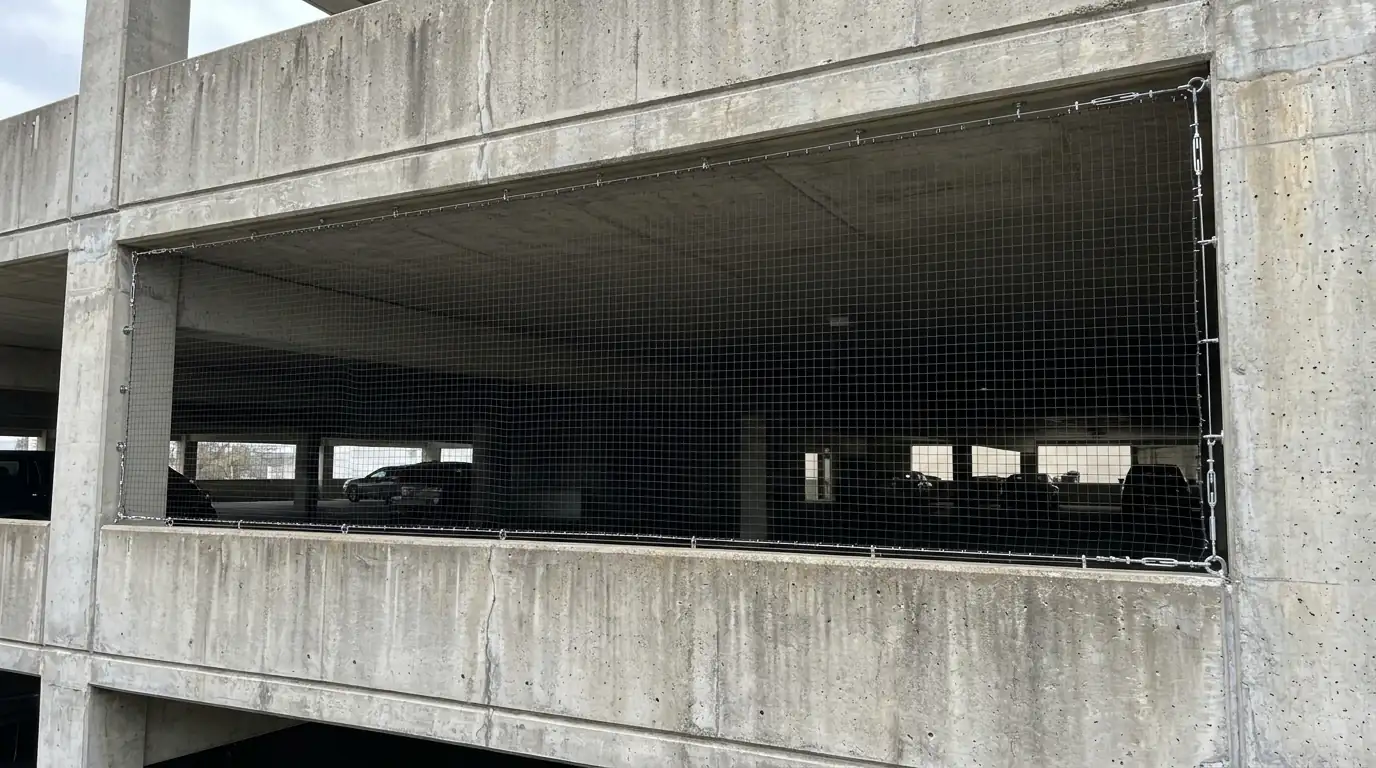
The strongest option for open areas: courtyards, parking structures, loading docks, alcoves and the undersides of canopies. Netting closes the entire volume so the birds simply cannot get in, installed with cable and fixings tensioned to the architecture so it looks deliberate rather than improvised. It is the most involved install and the most permanent, which makes it the right pick for areas where droppings fall on people, inventory or vehicles.
Spikes and ledges
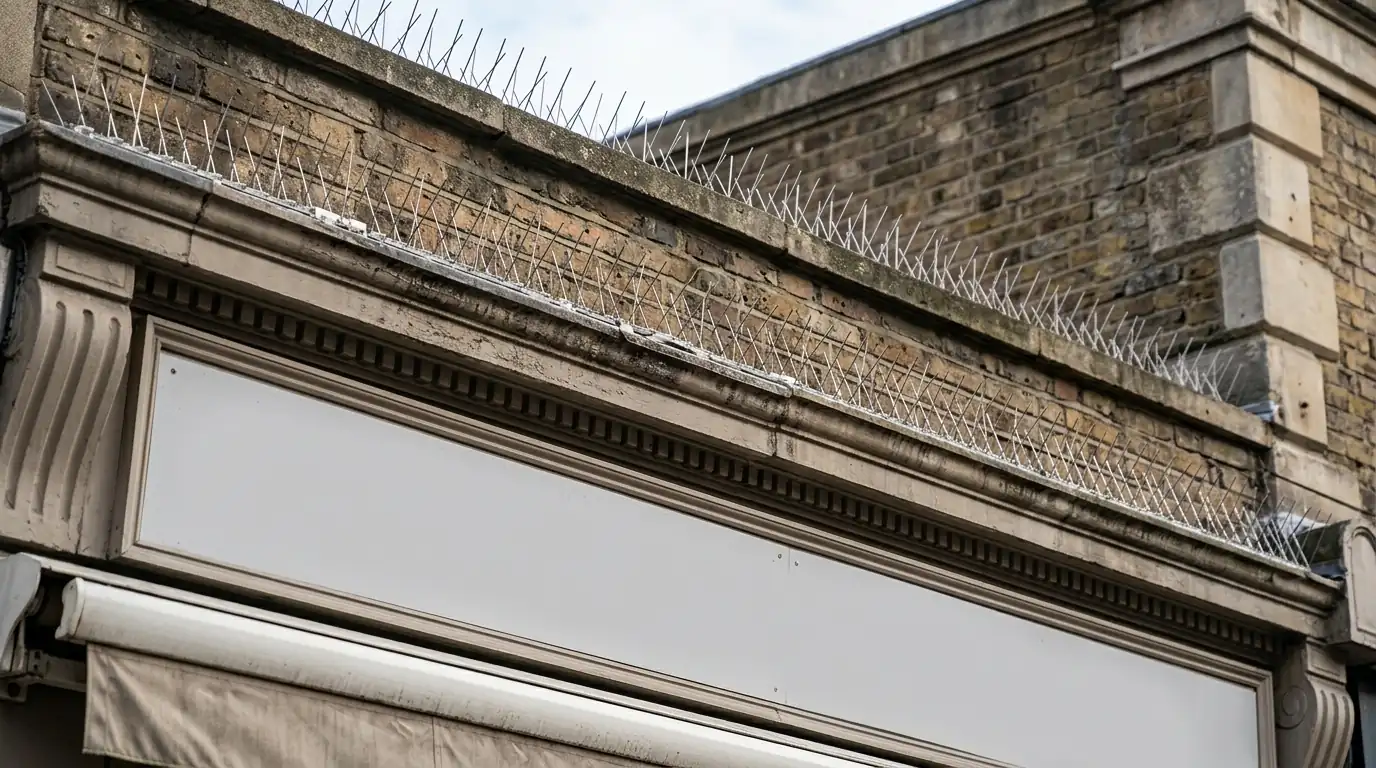
For narrow roosting surfaces, ledges, parapets, signs, light fixtures and beam tops, spikes or angled covers remove the flat landing surface. Stainless spikes do not harm birds; they simply remove the perch. Where a ledge is wide, an angled cover works better than spikes, since birds will stand between poorly spaced rows. Getting the spacing and coverage right is the difference between exclusion that holds and a ledge that becomes a nesting shelf with hardware on it.
Vent screens
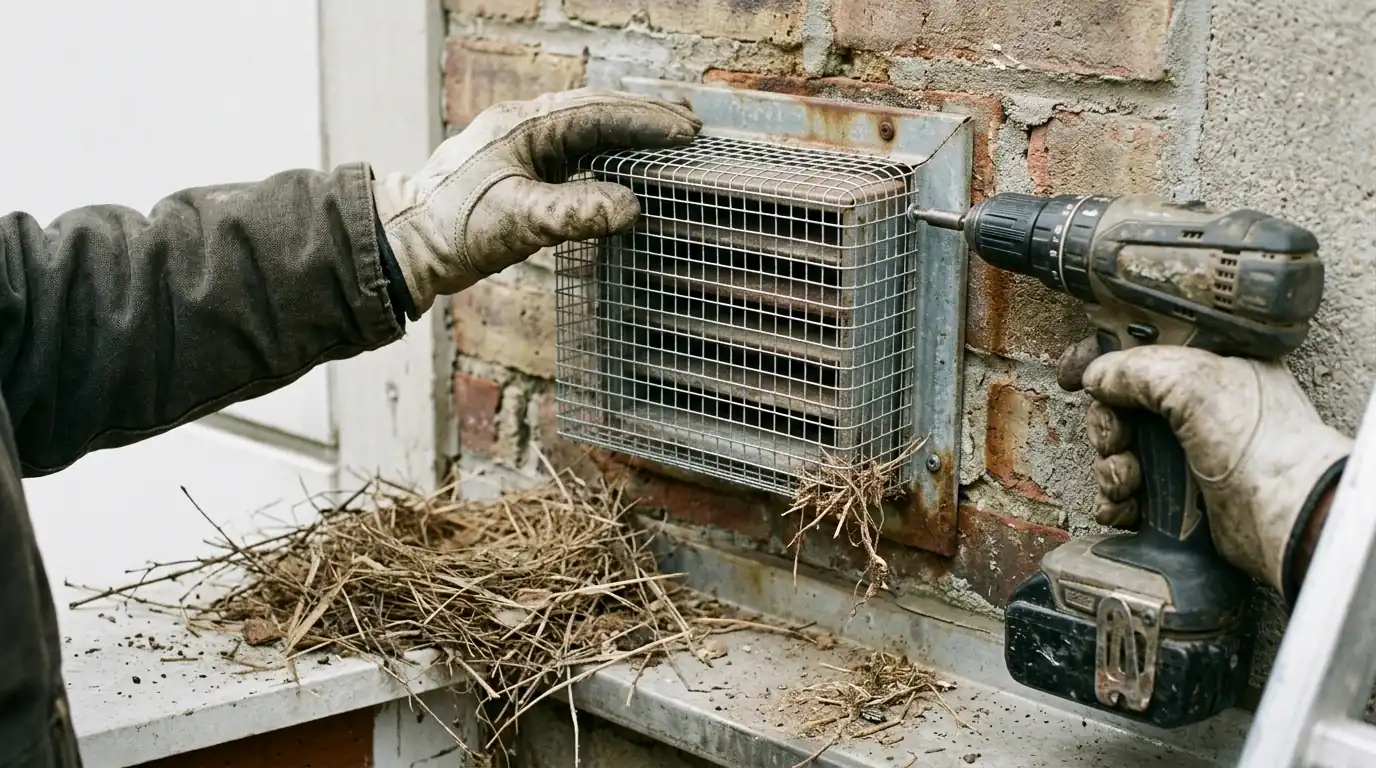
Dryer vents, exhaust outlets, attic and eave vents and sign cabinets are where nesting actually happens, and they are the most commonly missed part of a bird job. Each gets screened with mesh that keeps birds out while preserving airflow, after the cavity is checked and cleared. Nesting material in a vent is a fire and airflow problem as well as a pest one, which is why these get handled even when the visible issue is roosting somewhere else entirely.
How a bird job is sequenced
Site survey
Roosting points, nesting sites, droppings accumulation and access requirements all get mapped.
Check the legal picture
Species and active nests are identified, and the work is timed to comply.
Clean first
Droppings and nesting material are removed with proper controls before anything is installed.
Install exclusion
Netting, spikes, ledge angles and vent screens matched to each surface.
Review
A follow-up check catches any spot the birds shift to, which is normal on larger buildings.
Droppings on the entrance every morning? Let us survey the ledges.
Call (669) 369-0489What we see around San Jose
This is mostly a commercial and multi-unit problem in San Jose: retail frontages, parking structures, warehouse docks and apartment breezeways, where ledges, sign cabinets and covered walkways give birds exactly the sheltered flat surfaces they want. Residential calls do come in, usually nesting in a dryer vent or a patio cover, and those are smaller jobs. Either way the survey comes first, because the ledge you see from the sidewalk is rarely the only one in use.
More on this in Pest Watch: pest-proofing before the rains.